Store data for location analysis, geomarketing, and site planning
HomeStore data for location analysis, geomarketing, and site planning
Nationwide branch data for retail chains, financial service providers, and restaurants
Store location data provides a crucial foundation for site analyses, competitive assessments, and data-driven expansion strategies. Map and Route provides up-to-date, accurate, and geocoded store location data for retail chains and service providers.
Our database includes stores in Austria and approximately 600 retail chains with over 220,000 locations in Germany, and is continuously updated.
The data enables companies, consulting firms, and public institutions to systematically analyze locations, compare competitors, and strategically plan new branches.
Interested in licensing branch data? We offer customized datasets, including consulting and integration services.
Branch data consists of structured location information about companies with multiple branches or locations.
It falls under the category of and serves as a key data source for location analysis, geomarketing, and market analysis.
A branch data record typically includes:
Company Name
Branch Location (Address)
Geographic Coordinates
Industry
Chain Affiliation
In addition, a wide range of supplementary information based on master data can be added.
Map and Route's store database
Our store data portfolio currently includes approximately 600 retail chains with over 220,000 locations in Germany.
Typical retail chains include, for example:
Gas stations
Pharmacies
Supermarkets and grocery stores
Restaurants and eateries
Bakeries
Fitness centers
Home improvement stores
Clothing retailers
Car dealerships and auto repair shops
Wholesale markets
Banks
Insurance agencies
Additional industries are available depending on the data source.
Scope of Store Master Data
In addition to the actual location information, our branch records may contain additional structured attributes, such as:
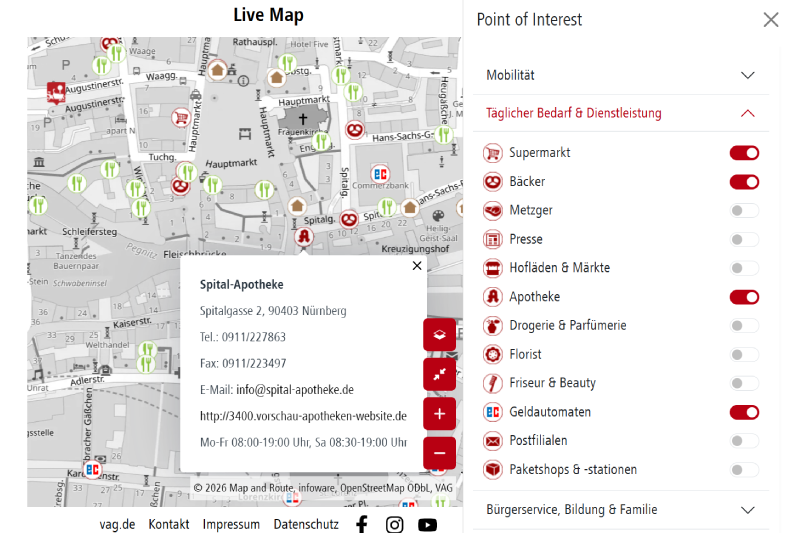
Hours of operation (including emergency hours for pharmacies)
Payment options
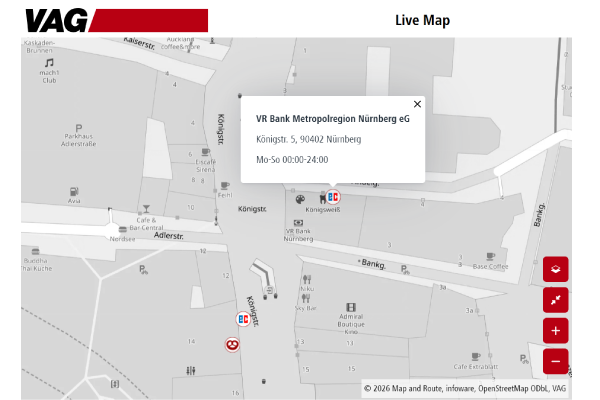
Cash services (cash withdrawals at retail locations)
Accessibility Parking
Baby changing stations
Amenities such as
coffee machines
On-site and nearby electric vehicle charging stations
Nearby public transportation stops
Gas stations also provide fuel prices updated in real time.
Site Analysis and Expansion Planning
Companies analyze existing store networks and identify new locations with high market potential. This involves, among other things, examining the density of retail outlets (e.g., the concentration of retail businesses in a given area)
Competitive Analysis
Store data enables a precise analysis of competitors and their location distribution
Geomarketing and Outdoor Advertising
By combining store data with mobility data, it is possible to analyze customer flows and catchment areas in terms of “mobile purchasing power.”
Site evaluation for investments
Real estate developers, banks, and investors use retail location data to conduct data-driven assessments of retail and commercial sites. When combined with other POI data, this information can be used to determine, among other things, the level of retail offerings in an area (e.g., a concentration of luxury retail chains versus a concentration of arcades) or identify trendy locations.
Branch data refers to structured location information about companies with multiple branches or locations. Typical industries in this category include gas stations, supermarkets, pharmacies, and insurance agencies.
How extensive is the store database?
The database currently includes approximately 600 retail chains with over 220,000 locations in Germany. Data on retail locations in Austria is also available—data for other countries is available upon request.
What additional information is included in the store data?
Depending on the dataset, it may include information such as opening hours, payment options, accessibility, parking, or cash services.
How up-to-date is the store information?
The data is updated on a quarterly basis. Gas station prices are updated in real time.
What should you look for when purchasing store data?
High-quality store data is characterized by up-to-date information, precise geocoding, complete master data, and broad coverage of relevant retail chains. In addition, structured supplementary information such as opening hours, payment options, or available infrastructure (e.g., parking spaces or EV charging stations) is crucial for reliably conducting location analyses, competitive assessments, and geomarketing analyses.
For which use cases is branch data particularly well-suited?
Store data is particularly useful for location analysis, expansion planning, competitive analysis, geomarketing, and the assessment of catchment areas and foot traffic—especially when combined with mobility data.
Can branch data be combined with other data sources?
The data is provided in standard formats or via an API, enabling easy integration into GIS systems, planning software, navigation solutions, or custom applications.
In what formats is store data provided?
Branch data is typically provided as structured data sets (e.g., CSV, XLSX) or as separate data layers for mapping and navigation solutions—depending on the use case and system environment.