Geomarketing data for location analysis and expansion
HomeGeomarketing data for location analysis and expansion
Data-driven decision-making tools for retail chains, management consultancies, and geomarketing solution providers
Geomarketing is now a central component of data-driven business models. Retail chains, geomarketing agencies, and management consultancies use location-based data to gain a more precise understanding of target audiences, analyze markets, and make informed location decisions.
Map and Route provides the necessary data for this—ranging from mobility data and store data to comprehensive POI data—and supports its integration into analytics, planning, and other software systems.
Geomarketing as a data-driven decision-making discipline
Geomarketing expands the traditional marketing approach by adding a spatial perspective. It is not just about optimizing products, prices, or communication, but about understanding how markets, target groups, and demand are distributed and evolve across space.
It is not a single method, but a discipline that combines various data, models, and analytical techniques to provide well-founded answers to spatial questions.
Key spatial questions include, for example:
Where are the relevant target groups located—and how do they move around?
Which locations have the highest potential for demand?
How do competition and infrastructure affect a location’s performance?
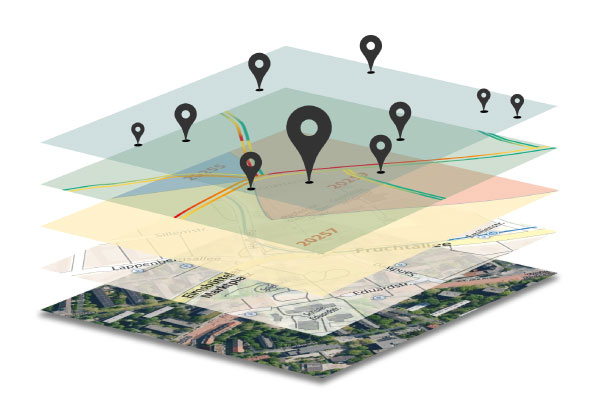
This is based on a combination of various data sources:
Only by linking this data can we establish a solid foundation for decision-making regarding strategic and operational measures.
What geomarketing data is needed—and what is it used for?
In geomarketing, different types of data are not considered in isolation but are specifically combined to answer specific questions—ranging from site evaluation to campaign optimization within media planning.
Mobility Data for Geomarketing: Analyzing Movement, Frequency, and Catchment Areas
Mobility data (e.g., floating car data and floating truck data) show how people and goods actually move through space. It is used, for example, for:
Analysis of traffic flows and volumes
Determination of actual catchment areas
Assessment of pedestrian and visitor traffic
Identification of location potential along transportation corridors (e.g., for commercial real estate)
Store and Competitive Data: Market Structure, Competition, and Location Comparison
Branch data (e.g., on retail chains, banks, pharmacies, restaurants, and hotels) provides the basis for analyzing market structures. It is used, for example, for:
Assessment of competitive intensity
Analysis of store networks and market distribution
POI Data (Points of Interest): Location Context and Infrastructure in Geomarketing
POI data enriches the analysis by providing the functional and infrastructural context of a location.
We distinguish between static POI data (e.g., ATMs, parking lots, charging infrastructure) and dynamic POI data (e.g., construction sites, gas prices, or cash services in retail). They are used for:
Assessment of location attractiveness
Analysis of foot traffic drivers and service offerings
Risk analyses (e.g., of locations with ATMs for insurance companies or state criminal investigation offices)
Dynamic adjustment of media campaigns such as outdoor advertising
Combining this data enables concrete, data-driven decisions across various fields of application.
Filialnetz optimieren: Standortanalyse, Expansion und Konsolidierung
Site selection decisions are long-term and capital-intensive. At the same time, demand, mobility, and competition are constantly changing. A static assessment is therefore insufficient.
Key analytical perspectives:
Catchment areas and cannibalization effects (mobility data)
Actual demand and foot traffic (mobility data)
Competitive landscape (store data)
Agglomeration effects and neighborhood quality (POI data)
Accessibility and mobility (mobility data)
Result: A data-driven overhaul of the store network, featuring clearly prioritized expansion opportunities, optimized existing locations, and the targeted reduction of inefficient structures.
Target Audience and Frequency Analyses in Geomarketing
For effective geomarketing, it is crucial to understand where target audiences are located, how they move around, and how long they stay in specific locations. Only on this basis can campaigns be precisely targeted and locations effectively evaluated.
Analysis of visitor flows (mobility data)
Identification of relevant target groups (mobility data)
Assessment of dwell times and usage patterns (mobility data + POI data)
Planning of outdoor advertising locations (mobility data)
Regional campaign management (mobility data + POI data)
Result: Significantly greater campaign targeting accuracy, as well as a realistic assessment of location and foot traffic potential.
Sales and Territory Planning Using Geodata
Geographic data also plays a key role in sales organization. The goal is to structure territories in such a way that market potential is maximized while avoiding inefficient overlaps.
Optimization of sales territories (mobility data + store data)
Reduction of overlaps (store data)
More efficient use of resources (mobility data)
Result: More efficient sales structures, better market coverage, and a more targeted use of existing resources.
Combining Geodata: A Key Competitive Advantage and a Challenge at the Same Time
The greatest value is created by integrating various data sources:
Mobility data + store data → actual purchasing power flows
POI data + foot traffic data → location attractiveness
Internal + external data → customized analyses
In practice, however, the problem lies less in the availability of individual data points and more in the consistent integration of that data. Different data formats, inconsistencies in geocoding, and a lack of standardization complicate integration and diminish the value of the analyses. As a result, approximately 37% of companies report challenges with integrating spatial data.* Map and Route addresses this exact issue by helping to systematically consolidate and harmonize data sources and convert them into a consistent data model. This creates a robust foundation for sound analyses and data-driven decisions.
Trend: Predictive Geomarketing: From Analysis to Forecasting
Geomarketing is currently evolving from a purely descriptive approach to a forward-looking, model-based decision-making discipline. While traditional analyses explain past foot traffic and location performance, predictive methods enable the anticipation of future developments—such as where demand will be concentrated, how target groups move, and which locations will gain relevance in the medium term. At their core, predictive models combine historical mobility, store, and POI data with statistical and algorithmic methods. Among other things, this allows us to deduce:
Demand hotspots based on time of day, day of the week, and seasonal factors
Movement patterns of target groups and how they change under different conditions
Location potential for expansion, relocation, or consolidation
For businesses, this means a shift from reactive to proactive decision-making: campaigns are no longer placed solely in areas with high foot traffic today, but rather where future demand is most likely to arise. Similarly, location decisions can be made earlier and with greater confidence, as scenarios and trends are simulated in advance.
Accordingly, around 54% of companies are already planning investments in predictive geo-analytics to drive their location and marketing decisions with data and systematically build competitive advantages.*
Integrating geomarketing data into your systems
For practical use in geomarketing, it is not only data quality that is crucial, but above all its seamless integration into existing system landscapes. This is the only way to conduct analyses efficiently and directly support operational processes. The data can be integrated into:
Geomarketing platforms
GIS systems
BI tools
Mapping solutions
Map and Route provides structured datasets in this area covering mobility, retail chains, ATMs/cash services, as well as static and dynamic POI information.
The data is either delivered directly in the desired format or embedded in a separate data layer that can be integrated into a mapping solution such as here.
Buy geomarketing data
The analyses and use cases described above show that the key value of geomarketing comes from the careful selection and combination of the right data sources.
Are you interested in purchasing or licensing geomarketing data? We can help you with that:
select the right data sources for your specific use case
combine different datasets in a meaningful way
create a solid foundation for decision-making in your projects
Why choose Map and Route as your geomarketing data provider?
In addition to providing data, geomarketing relies heavily on the ability to interpret and combine data correctly and integrate it into existing systems.
Map and Route combines data expertise with practical application experience:
Over 25 years of experience with geospatial data
A unique data network spanning traditional and non-traditional data sources
Combination and integration of various data sources
High data quality and up-to-date information
Integration into existing systems and applications
GDPR-compliant data provision and processing
Let's talk about your geomarketing project
Are you looking to leverage geomarketing data to make informed location decisions, optimize campaigns, or expand your branch network?
Together, we’ll analyze your needs and show you which combination of data offers the greatest value for your specific use case.
What data is particularly relevant for geomarketing?
Geomarketing relies in particular on mobility data, store and competitor data, and POI data. While mobility data reflects movement patterns and frequencies, store data provides insights into market structures and competition. POI data supplements this information by providing the infrastructural context of a location.
What exactly is geomarketing data used for?
Geomarketing data is used for location analysis, store network optimization, target audience analysis, sales planning, and the planning and optimization of marketing campaigns. It enables data-driven decisions throughout the entire marketing and expansion process.
Can you buy geomarketing data, or is it licensed?
Geomarketing data is generally not “purchased” in the traditional sense, but rather licensed. This means that companies can use the data for specific purposes and time periods without becoming the owners of the data.
How up-to-date is geomarketing data?
The frequency of updates depends on the type of data. While static data, such as store locations, is updated regularly, dynamic data—such as traffic or gas station data—can be provided nearly in real time.
How are different data sources combined in geomarketing?
The data is integrated using common spatial reference systems (e.g., geographic coordinates). In this process, different datasets are harmonized, linked, and analyzed to obtain a consistent overall picture of locations, movements, and market potential.
Is geomarketing data GDPR-compliant?
Yes, provided that the data is anonymized and aggregated. Personal data is not processed in professional geomarketing, so its use complies with the requirements of the GDPR.
For which industries is geomarketing data relevant?
Geomarketing data is used in a variety of sectors, including retail, logistics, insurance, the financial sector, public institutions, as well as by agencies and management consultancies.
How can geomarketing data be integrated into existing systems?
Integration is typically achieved through APIs, standardized data formats, or custom data layers. This allows the data to be integrated into GIS systems, BI tools, geomarketing platforms, or proprietary software solutions.